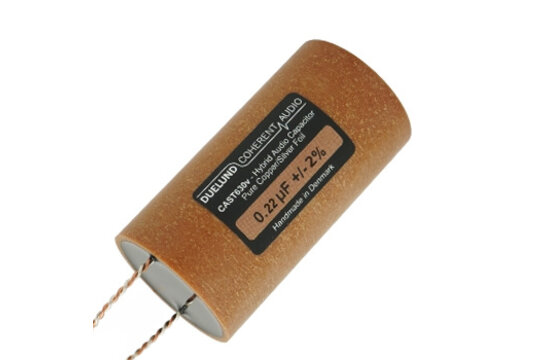
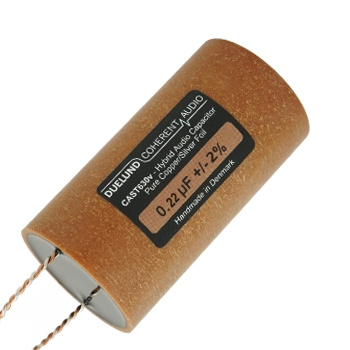
The Duelund Coherent Audio CAST-PIO-CU-AG-630-1,0 is a high-end CAST paper-in-oil capacitor made for demanding audio applications where natural sound, low losses and strong mechanical damping are essential.
Highlights of the Duelund Coherent Audio CAST-PIO-CU-AG-630-1,0
- CAST paper-in-oil construction for premium audio performance
- Built on Duelund’s Virtual Stack Foil design principle
- WPIO dielectricum with high-pressure impregnation for several days
- Excellent damping properties and very high mechanical stability
- DCA16GA wire lead-outs for high-quality connection
- Suitable for crossover networks, signal coupling, bypassing and filtering
Product details Duelund Coherent Audio CAST-PIO-CU-AG-630-1,0
Duelund Coherent Audio CAST-PIO-CU-AG-630-1,0 1,0 µF 2% 630 V CAST Paper in Oil Copper-Silver Capacitor
The Duelund Coherent Audio CAST-PIO-CU-AG-630-1,0 is part of the CAST PIO capacitor range, developed for high-end audio systems that demand precise, natural and stable signal behaviour. As one of the premium capacitors for audio use, it is suited to refined loudspeaker and electronics projects where component quality has a direct influence on clarity, tonality and realism.
The construction builds on Duelund’s Virtual Stack Foil design, a principle created to minimise losses, distortion and microphonics. The CAST series uses pure metal foils with WPIO impregnation, and the dielectricum undergoes several days of high-pressure impregnation. This process contributes to the capacitor’s strong damping characteristics and exceptional mechanical stability.
For use in crossover components, signal paths and filtering applications, the CAST PIO design is made to support effortless musical flow and high transparency. Duelund capacitors are suitable for crossover networks, signal coupling, bypassing and filtering in speakers, amplifiers, preamplifiers, DACs, CD players and other audio equipment.
The capacitor is fitted with Duelund DCA16GA wire lead-outs. The outer lead-out, positioned closest to the edge of the capacitor, is connected to the outer foil and should be connected to the lowest impedance path to ground for correct orientation in the circuit.
Show more
Show less


 New products
  Home audio
  Audio components
  Crossover components
  Test & measurement
  DIY kits
  Accessories
  SALE
SALE  New products
 Speakers
 Amplifiers
 DAC converters
 DSP modules
 Turntables
 Streamers
 Woofers
 Tweeters
 Exciters
 Bass shakers
 Plate amplifiers
 Amplifier modules
 Single board computers
 Assembled crossovers
 Printed Circuit Boards (PCB)
 Capacitors
 Resistors
 Coils
Coils Circuit Breakers
 Crossover tools
 Screw terminals
 Acoustic measurements
 Electric measurements
 Sound level meters
 DIY amplifier kits
 DIY component packs
 DIY speaker kit
 DIY subwoofer kits
 DIY bluetooth speaker
 DIY electronics kits
 Binding posts
 Cabinet Hardware
 Cables
 Connectors
 Speaker cabinets
 Electromechanics
 Power supplies
 Speaker repair
 Workshop & tools
 Amplifier accessories
 Stands & mounts
 Gift voucher
 Books
Books SALE
SALE









 New products
 Speakers
 Amplifiers
 DAC converters
 DSP modules
 Turntables
 Streamers
 Woofers
 Tweeters
 Exciters
 Bass shakers
 Plate amplifiers
 Amplifier modules
 Single board computers
 Assembled crossovers
 Printed Circuit Boards (PCB)
 Capacitors
 Resistors
 Coils
Coils Circuit Breakers
 Crossover tools
 Screw terminals
 Acoustic measurements
 Electric measurements
 Sound level meters
 DIY amplifier kits
 DIY component packs
 DIY speaker kit
 DIY subwoofer kits
 DIY bluetooth speaker
 DIY electronics kits
 Binding posts
 Cabinet Hardware
 Cables
 Connectors
 Speaker cabinets
 Electromechanics
 Power supplies
 Speaker repair
 Workshop & tools
 Amplifier accessories
 Stands & mounts
 Gift voucher
 Books
Books SALE
SALE