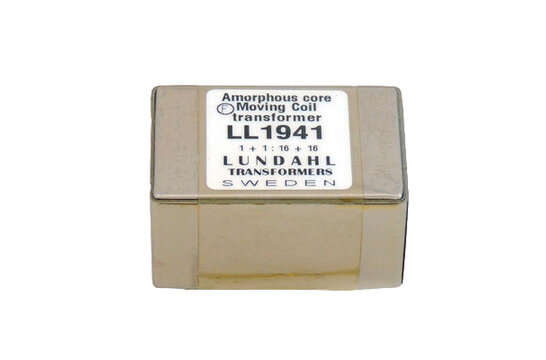
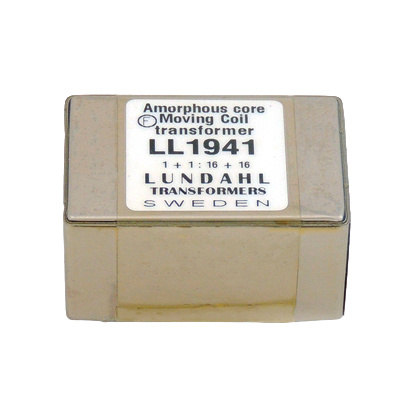
The Lundahl LL1941 is a cost-no-object moving coil step-up transformer for low-output MC cartridges, combining an uncut amorphous cobalt core, dual-coil construction, Cardas high-purity copper wire and mu-metal shielding.
Highlights of the Lundahl LL1941
- High turns-ratio moving coil step-up transformer for low-output MC cartridges
- Uncut amorphous cobalt core with oversized dual-coil construction
- Cardas high-purity copper wire for uncompromising signal handling
- Mu-metal can improves shielding against external magnetic fields
- Connection options for 1:16 and 1:32 step-up ratios
- 10 Hz to 100 kHz frequency response at +/- 1.0 dB in serial connection
Product details Lundahl LL1941
Lundahl LL1941 Amorphous Core Moving Coil Input Transformer
The Lundahl LL1941 is designed as a premium audio component for moving coil cartridge input stages. It is a high turns-ratio version of Lundahl’s LL1931 moving coil step-up transformer, developed specifically for low-output MC cartridges where maximum signal integrity and low noise pickup are essential.
At the heart of the LL1941 is Lundahl’s unique uncut amorphous cobalt core, combined with a dual-coil structure and Cardas high-purity copper wire. This oversized construction is intended to deliver the best possible MC transformer performance, while the dual-coil layout greatly improves immunity to external magnetic fields from power supplies, motors and similar sources in high-end home audio systems.
The transformer offers a turns ratio of 1 + 1 : 16 + 16 and supports multiple connection alternatives, including serial-serial connection for 1:16 and parallel-serial connection for 1:32. In serial connection with a 10 Ω source and open secondaries, the LL1941 delivers a frequency response of 10 Hz to 100 kHz within +/- 1.0 dB.
For integration into a phono preamplifier or custom MC input stage, the LL1941 is housed in a mu-metal can and uses PCB pins with 5.08 mm spacing and 30.5 mm row spacing. The transformer measures 43 x 28 x 22 mm above the PCB and weighs 90 g. Each primary has a static resistance of 0.8 Ω, each secondary has a static resistance of 105 Ω, and isolation is rated at 3 kV between windings and 1.5 kV between windings and core.
Show more
Show less


 New products
  Home audio
  Audio components
  Crossover components
  Test & measurement
  DIY kits
  Accessories
  SALE
SALE  New products
 Speakers
 Amplifiers
 DAC converters
 DSP modules
 Turntables
 Streamers
 Woofers
 Tweeters
 Exciters
 Bass shakers
 Plate amplifiers
 Amplifier modules
 Single board computers
 Assembled crossovers
 Printed Circuit Boards (PCB)
 Capacitors
 Resistors
 Coils
Coils Circuit Breakers
 Crossover tools
 Screw terminals
 Acoustic measurements
 Electric measurements
 Sound level meters
 DIY amplifier kits
 DIY component packs
 DIY speaker kit
 DIY subwoofer kits
 DIY bluetooth speaker
 DIY electronics kits
 Binding posts
 Cabinet Hardware
 Cables
 Connectors
 Speaker cabinets
 Electromechanics
 Power supplies
 Speaker repair
 Workshop & tools
 Amplifier accessories
 Stands & mounts
 Gift voucher
 Books
Books SALE
SALE









 New products
 Speakers
 Amplifiers
 DAC converters
 DSP modules
 Turntables
 Streamers
 Woofers
 Tweeters
 Exciters
 Bass shakers
 Plate amplifiers
 Amplifier modules
 Single board computers
 Assembled crossovers
 Printed Circuit Boards (PCB)
 Capacitors
 Resistors
 Coils
Coils Circuit Breakers
 Crossover tools
 Screw terminals
 Acoustic measurements
 Electric measurements
 Sound level meters
 DIY amplifier kits
 DIY component packs
 DIY speaker kit
 DIY subwoofer kits
 DIY bluetooth speaker
 DIY electronics kits
 Binding posts
 Cabinet Hardware
 Cables
 Connectors
 Speaker cabinets
 Electromechanics
 Power supplies
 Speaker repair
 Workshop & tools
 Amplifier accessories
 Stands & mounts
 Gift voucher
 Books
Books SALE
SALE